Now in beta, in the US first
Know yourself.
Grow together.
An app for singles, people who've just met someone, and couples. Every answer lights a spot on your own cartoon brain map, and your days collect in a journal. A few minutes a day.
Free during the beta. For adults 18 and over. On iPhone and Android.
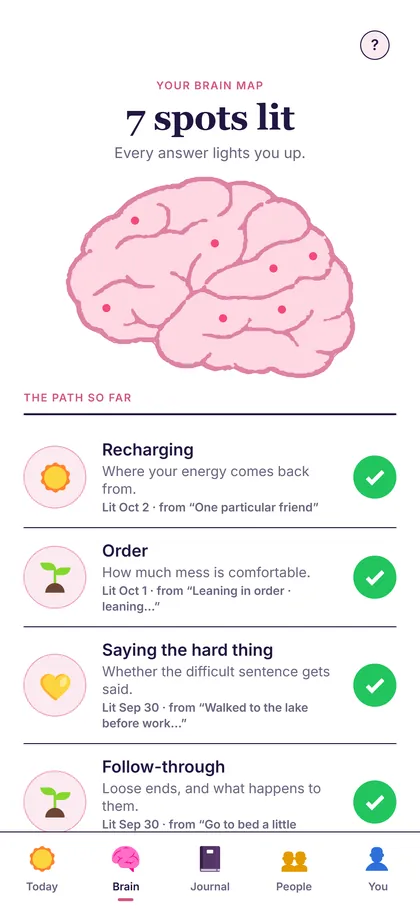
The map from the app. Its spots are a layout, not brain regions: a big spot means you've said a lot about it, not that you have more of it.
We'll never give you a compatibility score. Nobody can honestly predict that yet.
01
Your answers light your map.
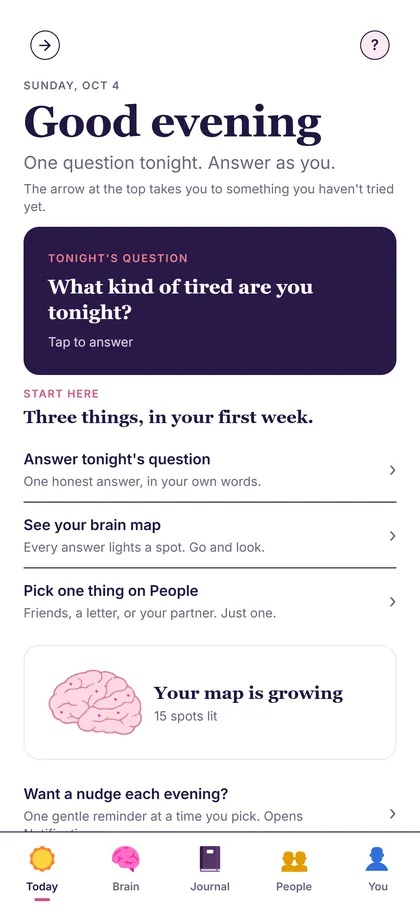
One question a day: tap, write, or drop a pin on a grid that reads your answer back in words. Every answer lights the spot it speaks to on your own cartoon brain map, and you can tap any spot to read what lit it.
- Eighteen traits in five sections, growing from seed to full grown as you share more.
- No scores, no grades, no comparing you with anyone. Growth is how much you've shared, never how strong a trait is.
02
Your days become a journal.
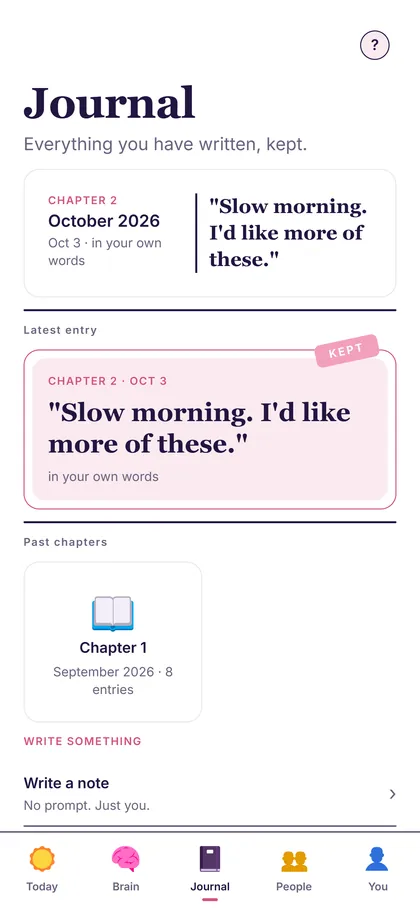
A few taps a day: tap a face for how today felt, then one thing from the day. Each tap saves on its own.
- Your journal keeps every day you've recorded, with its mood and what you wrote; a photo a day if you'd rather not write. Private unless you share one.
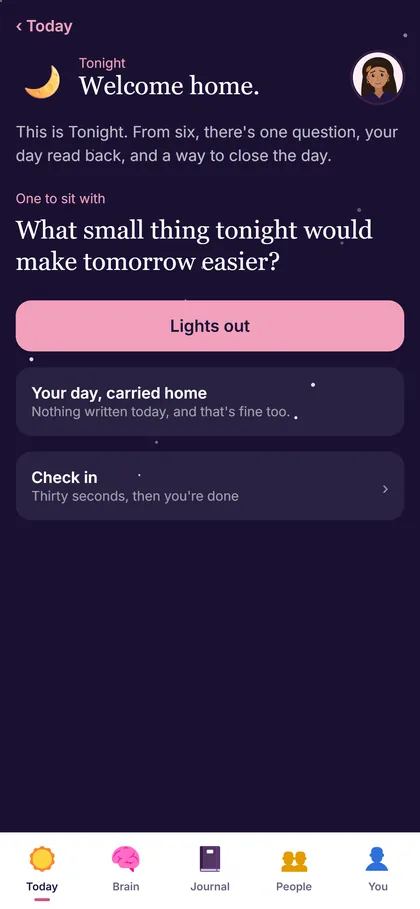
- From six in the evening, Tonight opens with tonight's question and your day read back, and Lights out to close it.
- Megan points you to one thing at a time. She's a character, not an AI: her lines are written by the BrainMatch team, and her voice is AI text-to-speech, made in advance.
03
For two.
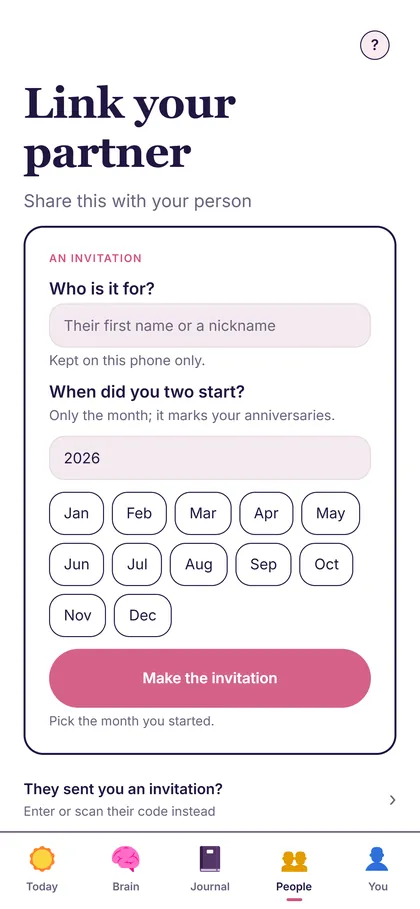
Couples link on their own phones. Neither sees the other's answers unless they share them, and every written answer has its own share switch, off by default.
- This or that: you both answer the day's question, and once you both have, you see each other's pick.
- Nobody can see whether their partner checked in, how much they wrote, or when they last opened the app.
- Friends you both say yes to can send each other things for their journals, added only if the other accepts.
04
Step into a place, on a headset.
BrainMatch also has spaces you can visit on a VR headset, in its web browser: made-up places like a corner cafe or a rooftop at dusk.
- The headset version is an early preview. Tick the box when you sign up, and we'll invite you when there's a spot.
- A line you write in a space, or a picture of the setting and your avatar, can go into your journal, only when you choose to keep it. It's never a camera picture of you or your room.
- More is on the way.
What the headset sees
Your headset follows your head and hands with its own cameras and sensors, on the headset itself. BrainMatch receives only the results: the position and turn of your head and of each hand. No camera picture or video of you is ever sent or stored.
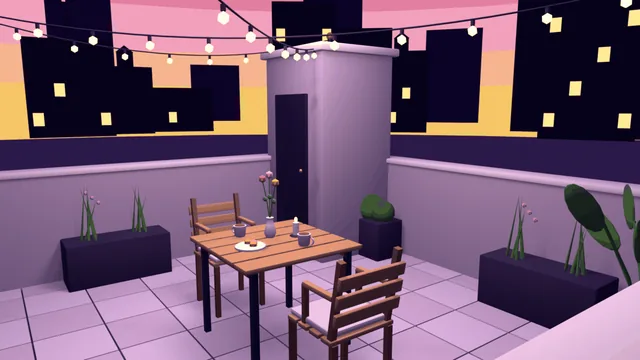
"Rooftop at dusk": the space's own 3D model, the space's own 3D model, rendered by us. It's a made-up place, and nothing here is a photo.
05
Private by default.
What you write is yours. A partner sees only what you choose to share. The full statement is on the privacy and data use page.
A switch for everything
Every kind of data has its own switch. Turning one off deletes what it covered.
Yours to take or delete
See everything stored about you, export it, or delete your account at any time.
No ads
No ads, and no third-party analytics. No passwords either: you sign in with a code sent to your email, or a passkey.
How AI is, and isn't, used
An AI run by Anthropic reads your own written answers to write your nightly question and what your spots mean; never a partner's or friend's words. Megan's lines are still written by the BrainMatch team, and her voice is AI text-to-speech made in advance. It's a switch of your own, and it starts off. With it off, nothing of yours is sent to any AI, and tonight's question and what each spot means are written from your own words by fixed rules.
Who it's for
Adults 18 and over. The beta is open to people in the United States first; other countries follow once the legal groundwork is done for each.
What your answers are used for
Everything you answer builds your own record: your brain map, your journal, your monthly recap. It's there so you can see your own journey, and it's yours to export or delete at any time.
If you're in a couple, the reports, things to say, and songs work from what each of you chooses to share. Your partner never sees anything you haven't shared.
Questionnaire and check-in answers are analyzed together to learn what good matches look like and to build BrainMatch's matching. We call this matching data. It's filed under a random id, never your name or email, alongside your birth year, whether you're single or in a couple, when your relationship started, how you met (if you meet someone here). That makes it pseudonymised, not anonymous: the id links your answers over time and to your partner's, so it's still treated as your personal data. It never includes your writing, your email, or your gender and the gender you're looking for. “Help build matching” controls whether yours is used to build matching features.
An AI reads your own written answers to write two things for you: tonight's question, which follows what you've been writing, and a few sentences on what your own words lit each spot on your map with. What's sent is your written answers to the daily question and the Monday Mix questions: only yours, never a partner's, a buddy's or a friend's, and never your name or email. The model is run by Anthropic, under a data-processing agreement, and your answers are not used to train its models. What comes back is shown to you alone, kept with your account, in your export and deleted with it. It's a switch of your own (“An AI reads your answers”, at Join and in Privacy): off, nothing of yours is sent and your prompts and insights are written from your own words by fixed rules; on, they're a little more on the money. Nothing else you write goes to any AI: not photos, not letters, not notes to a partner, not what the two of you share. Megan is still a written character: her lines are ours, picked by simple rules, and her voice is AI text-to-speech recorded in advance. If you turn on “Help build matching”, your pseudonymised answers (under a random id, never your name or email) may be used to train the models behind future matching.
If something you write names a day ahead, like “interview Thursday”, Megan asks how it went on that day. That's a simple rule that spots the word “tomorrow” or a day's name, on your phone's own words, and nothing else. Your answer stays in your journal.
The beta
Be one of the first.
We're in beta, and we're keeping the details close until launch. Beta testers see everything first.
Free during the beta. For adults 18 and over. The beta is open to people in the United States first; other countries follow once the legal groundwork is done for each.